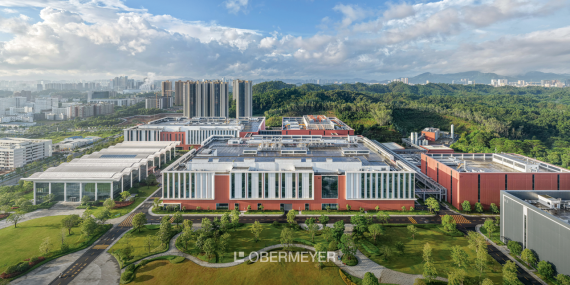
The Completion of a Precision Manufacturing Park
As global high-end manufacturing evolves rapidly, industrial parks are no longer just production spaces. They are becoming hybrid spaces that combine scientific logic, industrial aesthetics and human-centered design.
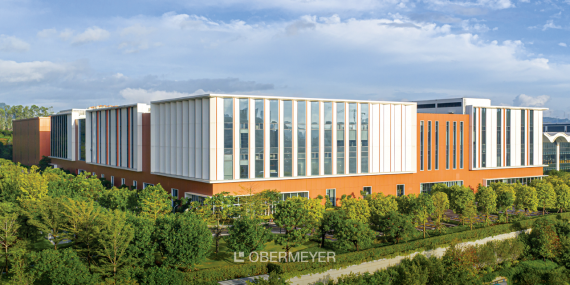
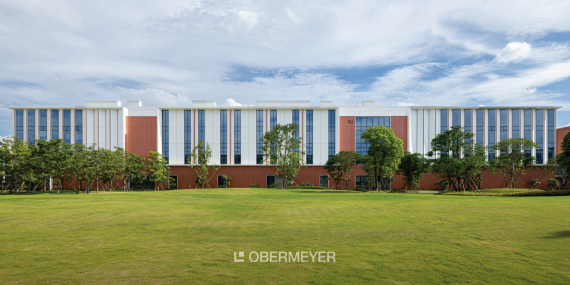
Commissioned by a world-leading technology company, OBERMEYER took on the architectural design of its Shenzhen Jiulongshan Precision Manufacturing Park (Phase I). Our role covered concept design, schematic design, design reviews and construction support. The project has a total floor area of about 370,000 m², with three floors above ground and one basement. It includes workshops, a chemical warehouse, a canteen, offices and an energy station – a compact, future-ready industrial complex. The park was recently completed and has begun full-scale production and operations, becoming a new industrial landmark in Shenzhen's Jiulongshan area.
OBERMEYER the architectural style established for the company during its time at Songshan Lake Smart Manufacturing Park in Dongguan. For the Jiulongshan project, we introduced three core design principles: form follows function, classical aesthetic principles and structural rationality. These bring a sense of order and elegance to a high-tech industrial park.
- Form Follows Function
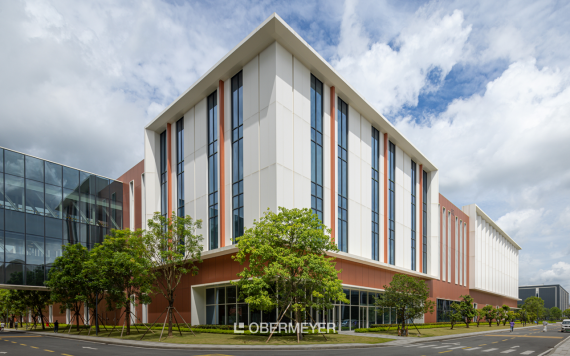
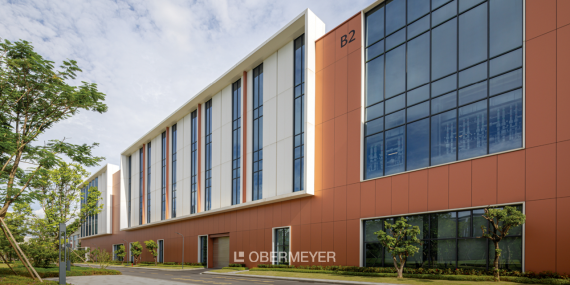
Solid surfaces form the background, adapting to the building's functional and spatial needs. Large solid walls meet the factory's requirements for thermal insulation, soundproofing, and cleanliness. They give the building a calm and restrained character, following the principle that all facade treatments first serve production and use.
- Classical Aesthetic Principles
The relationship between function and structure guides the division of solid and void surfaces, using rhythm, color, and unity. The position of frame elements matches the column grid, avoiding waste from later secondary structures.
The areas of solid-void change make use of the reinforced concrete frame's structural characteristics, creating visual lightness without compromising safety. Through precise proportion control, the building shows rich detail in a simple form.
- Structural Rationality
The relationship between function and structure guides the division of solid and void surfaces, using rhythm, color, and unity. The position of frame elements matches the column grid, avoiding waste from later secondary structures. The areas of solid-void change make use of the reinforced concrete frame's structural characteristics, creating visual lightness without compromising safety. Through precise proportion control, the building shows rich detail in a simple form.
From Songshan Lake, Dongguan to Jiulongshan, Shenzhen, OBERMEYER continues to create efficient, comfortable, and recognizable spaces for high-tech industrial production – with the practical approach of "form follows function," the graceful control of classical aesthetics, and the rigor of structural rationality. Even a factory or production line, when carefully designed, can become an architectural work worth observing, understanding, and appreciating.